Grizzly Appliance Repair fixes reach-in refrigerators and freezers, prep tables, undercounter units, bar coolers and merchandisers for restaurants, cafés, bars, stores and schools across the Denver metro. The commercial diagnostic is from $129, credited toward the repair.
A commercial refrigerator has a harder life than any appliance in a home. Its doors open hundreds of times a shift, it sits next to fryers, ovens and dish machines, and the air around it is full of flour, grease and dust. Most failures we see come back to three things: heat the unit cannot get rid of, air getting in where it should not, and water that has nowhere to go.
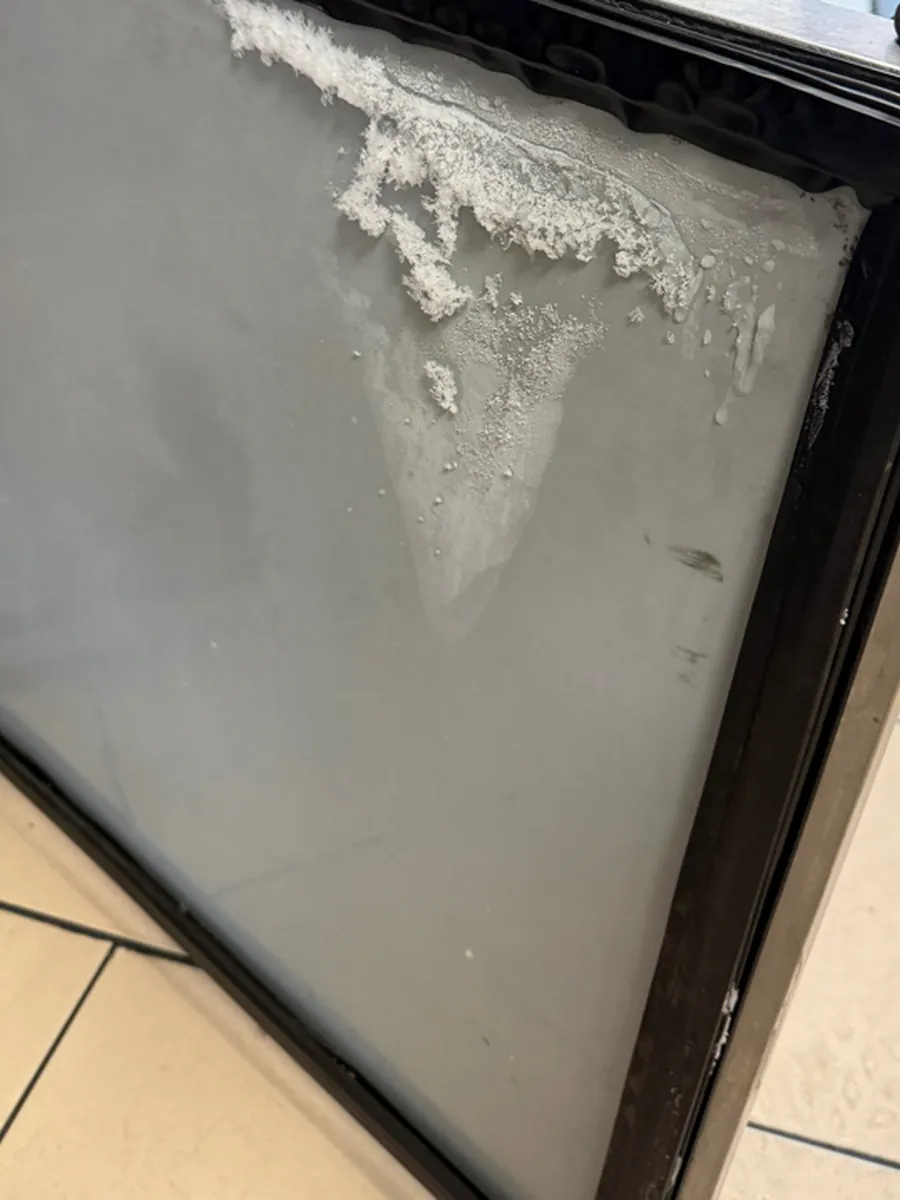
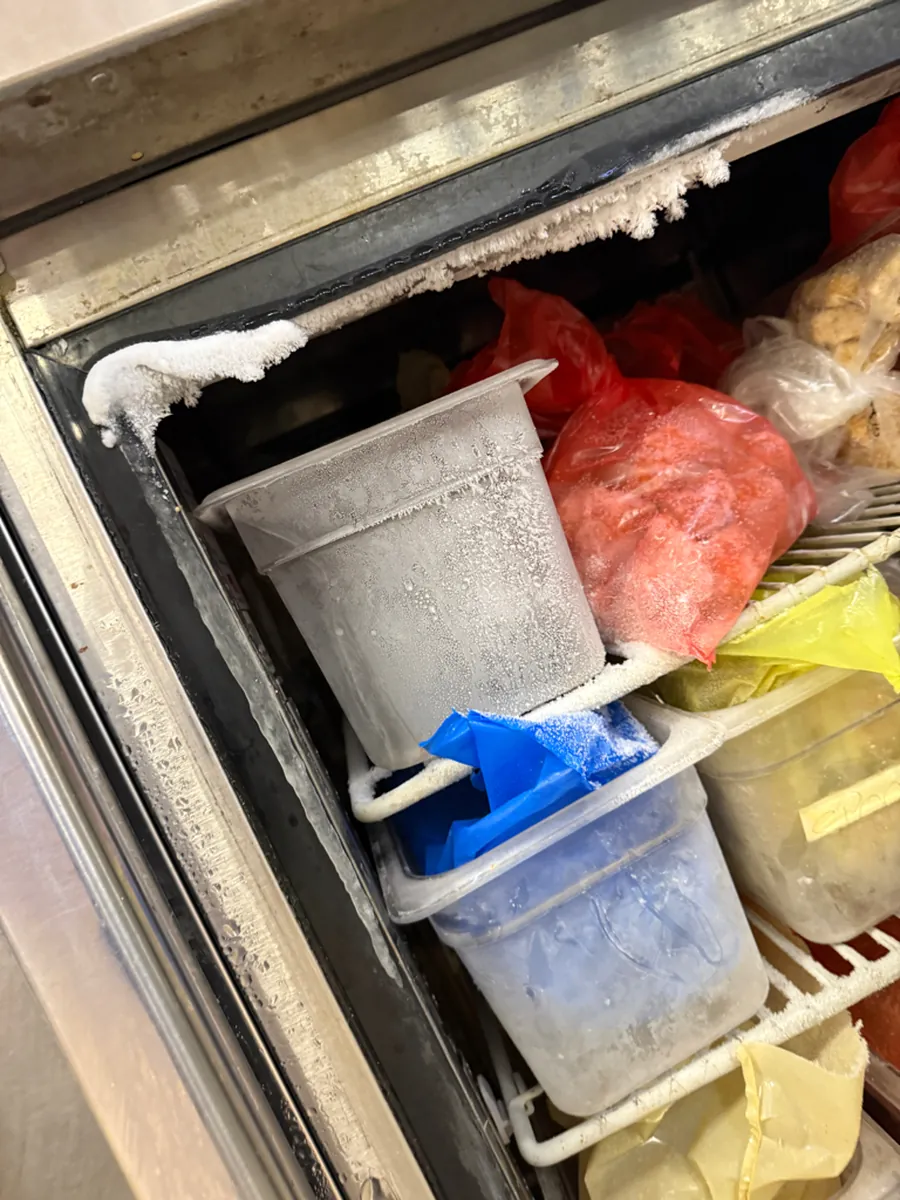
Frost on a door where a section of gasket was missing, Wheat Ridge.
Heat: the condenser
The condenser coil is where the refrigerator dumps the heat it removes from the cabinet. When the coil is matted with dust and grease, the compressor runs hotter and longer, cooling drops off on busy afternoons, and eventually the compressor fails. Cleaning the coil regularly is the single most effective thing you can do for a commercial refrigerator, and it is the first thing we check.
Air: doors and gaskets
Gaskets tear, harden and lose their magnetism. Hinges sag, closers stop pulling the door shut and carts bang doors out of alignment. Every gap lets warm, humid kitchen air in. The cabinet warms up, the evaporator ices over, and the compressor runs without a break. A gasket is an inexpensive part, and replacing it often fixes what looks like a big refrigeration problem.
Water: defrost and drains
Most commercial refrigerators defrost on a schedule and drain the meltwater to a pan where it evaporates. When the defrost heater, timer or control fails, ice builds up on the coil until air stops moving. When the drain clogs, water backs up into the cabinet or refreezes around the fan. Both look like "the fridge is warm" from the outside.
Controls and electrical
Thermostats, electronic controls, defrost timers, start relays, overloads and fan motors are the electrical wear parts. Heat and grease are hard on them too: we regularly find timers and connections with burn marks, which is why we inspect the wiring around a failed part instead of only swapping it.
Symptoms
Common problems, and what we do about them
Running warm, but the compressor is on
Usual causes. The single most common cause is a dirty condenser coil: dust, flour and grease stop the unit from rejecting heat. Also common: a failed condenser or evaporator fan, an iced evaporator, a door gasket that no longer seals, or a low refrigerant charge from a leak.
What we do. We clean and check the condenser first, check both fans, look at the evaporator and the gaskets, then measure pressures and temperatures if the cause is still hidden.
Completely warm, nothing running
Usual causes. No power to the controls or compressor: a tripped breaker, a failed thermostat or electronic control, a defrost timer stuck in defrost or burned out, damaged wiring, a bad start relay or overload, or a compressor that will not start.
What we do. We trace power from the plug to the compressor, test the control, the timer and the start components, and repair the actual fault, including the wiring if heat has damaged it.
Ice building inside the cabinet or on the coil
Usual causes. Warm, moist air getting in through torn or missing gasket sections, doors that do not close on their own, or a defrost system that has stopped working: heater, timer, termination thermostat or control.
What we do. We replace gaskets, adjust or repair hinges and closers, test the defrost circuit and clear the ice so the evaporator can breathe again.
Water on the floor or in the bottom of the cabinet
Usual causes. A clogged defrost drain, a cracked or overflowing drain pan, a drain line that has come loose, or a condensate evaporator pan with a failed heater.
What we do. We clear and flush the drain, check the pan and its heater, and fix whatever caused the water to back up.
Prep table rail is warm, cabinet is fine
Usual causes. Lids left open, pans overfilled above the rail, a rail fan that has stopped, or a unit that is losing capacity and can no longer keep up with the open top.
What we do. We check the rail airflow and fan, the lid and the pan setup, then test the system capacity so you know whether it is a usage issue or a repair.
Loud, rattling or buzzing
Usual causes. Fan blades hitting ice or debris, worn fan motor bearings, a loose condenser fan shroud, or a compressor that struggles to start and clicks off on overload.
What we do. We find the noise, replace worn fan motors, clear obstructions and test the compressor start circuit.
From our job log
Commercial refrigeration jobs from around the metro
Recent reach-in and undercounter calls, written from our technicians' notes. Photos are from the jobs themselves.
Ice along the door opening in Wheat Ridge, caused by a missing piece of door gasket.
Wheat Ridge · Store
Undercounter unit icing up and running warm
What we found. The unit was holding 45°F and ice was building along the door opening. A section of the door gasket was missing, so warm, moist air was leaking in and the compressor was running non-stop, a fast way to burn one out. The condenser coil was also dusty.
What we did. Replaced the door gasket, cleaned the condenser coil and tested the unit until it was cycling normally and holding temperature.
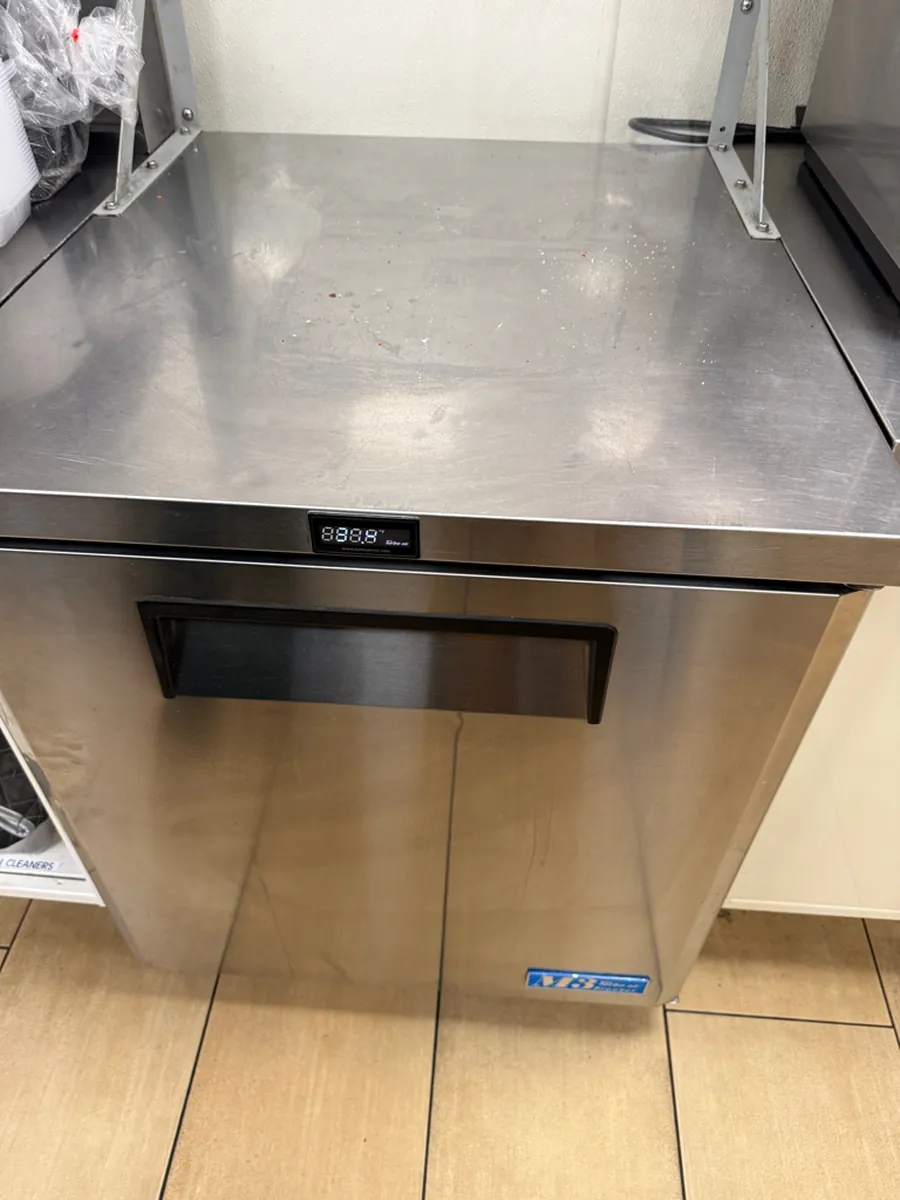
The undercounter refrigerator in Denver after the repair.
Denver
Undercounter refrigerator with no power to the compressor
What we found. The unit was warm and the compressor was not starting. There was no power reaching the thermostat or the compressor: the defrost timer had failed and its case showed signs of burning, and the wiring to it was damaged. The condenser coil was dusty too.
What we did. Repaired the damaged wiring, replaced the defrost timer, cleaned the condenser coil and confirmed the unit started, cooled and cycled correctly.
Littleton
Frost-free commercial freezer, warm and noisy
What we found. The freezer was not cooling properly and making noise. The defrost drain was blocked, so meltwater had nowhere to go.
What we did. Cleared and cleaned the drain, tested the defrost and the fans, and confirmed the freezer was pulling down to temperature.
By equipment
What is different about each type
Prep tables
A prep table has to keep an open rail of pans cold while the cook works over it, so it runs close to its limit all day. Overfilled pans, lids left up overnight and a rail fan that has quietly stopped all show up as a warm rail with a cold cabinet. When the whole unit runs warm, the condenser, which on many prep tables faces the kitchen floor, is usually caked with dust.
Undercounter units and chef bases
These live under griddles, charbroilers and counters, in the hottest air in the room. Their condensers clog quickly, their drawers take a beating, and drawer gaskets and slides wear out. We see more burned wiring and controls on chef bases than on any other type, because of the heat above them.
Bar coolers and back-bar units
Bottle and keg coolers are packed into tight millwork with little room to breathe. Most of their trouble is airflow: a condenser that pulls in the same hot air it just blew out. Spills and sugar get into drains and fans, and glass frosters add their own icing issues.
Glass-door merchandisers
Merchandisers in stores and cafés have big glass doors, lighting and often door heaters to keep the glass from sweating. A fogged door usually means a failed door heater or a humid store; a warm case with a running compressor usually means a dirty condenser or an iced coil. Door closers and gaskets wear quickly when customers open them all day.
Repair or replace?
Almost everything on a reach-in is replaceable: fans, controls, timers, gaskets, hinges, heaters and drains. The real decision comes with a compressor or sealed-system failure on an older, lower-cost unit, or a cabinet that is rusting through. In those cases we give you the repair price and our honest opinion side by side, so you can decide with real numbers.
Food safety
Temperatures to watch
Cold-held food needs to stay at 41°F or below. Most kitchens set reach-ins in the mid to upper 30s to leave a margin for door openings, and freezers around 0°F. Check and log temperatures at least twice a day, with a thermometer in the product or in a glass of water, not only the unit's display. A reach-in that reads fine at 7 a.m. and 44°F at 3 p.m. is losing capacity, and that is the best time to call: the unit still works, the product is still safe, and the repair is usually smaller.
If a unit fails with food inside, follow your food safety plan for how long product can stay above 41°F. Move what you can to another unit and keep the doors shut while you wait for us.
Prevention
A 10-minute monthly routine
Brush the condenser coil behind the front or rear grille. If it is greasy, call us for a proper chemical cleaning.
Run a hand around every door gasket. Look for tears, flattened spots and gaps. A dollar bill closed in the door should not slide out easily.
Check that doors close on their own from a half-open position.
Keep the evaporator clear. Do not stack product against the fan cover inside the cabinet.
Look under the unit for water and check that the drain pan is not overflowing.
Give it room. Units need space for air at the grille and, on many models, at the back.
If you would like us to look after several units on a schedule, ask when you call and we will set up a visit plan around your hours.
Pricing
What a commercial refrigerator repair costs
One diagnostic fee, credited toward the repair. The full price in writing before work starts.
Most reach-in and prep-table repairs are fans, controls, gaskets, timers, drains and coil cleaning. Sealed-system work is quoted separately once we know what failed. If a unit is not worth fixing, you will hear that before you spend money on it.
If a unit is low on refrigerant, it has a leak, and adding refrigerant without fixing it only buys time. We find the leak, recover the remaining refrigerant, repair it, replace the filter-drier, pressure-test with nitrogen, pull a deep vacuum and charge by the factory weight. Compressor replacements follow the same procedure, plus finding what killed the old compressor so the new one does not go the same way. Our technicians are EPA 608 certified.
FAQ
Commercial refrigerator questions
Call (719) 745-8080 with anything not covered here.
My reach-in is warm. Is there anything I can check before calling?
Make sure the unit is plugged in and the breaker is on, check that nothing is blocking the vents at the bottom or back, and look at the condenser coil behind the grille: if it is matted with dust, that alone can do it. Keep the doors closed, move sensitive food to another unit if you can, and call us.
How much does a commercial refrigerator service call cost?
The commercial diagnostic is from $129, credited toward the repair. You get the full repair price in writing before any work starts.
Which brands do you repair?
We work on the common commercial refrigeration brands, including True, Turbo Air and Everest, and most other reach-in, prep-table and merchandiser makers. We are independent, not a factory-authorized servicer.
How often should the condenser coil be cleaned?
Every three months is a good default in a commercial kitchen, and monthly for units next to fryers, griddles or bakery equipment. A clean coil is the cheapest insurance you can buy for a compressor.
Is it worth repairing an older reach-in?
Fans, controls, timers, gaskets, hinges and drains are worth repairing at almost any age. A compressor or sealed-system failure on an older, lower-cost unit is where replacement deserves a look, and we will give you both numbers.
Do you also fix walk-ins and ice machines?
Yes. We service walk-in coolers and freezers, ice machines, dish machines, commercial ovens and ranges, and commercial laundry, so one visit can cover more than one unit.